Wednesday, February 2, 2011

Part I: Looking Towards a New Paradigm of Art Participation


In this country we use the words society and cultural, interchangeably with the connotation that part of the spectrum is not available to most of us; as in high society and level of sophistication, as in cultured. I want to make the distinction between the word society as social structure, bound, by similar traditions, and the word culture, as the cultivation and expression of humans need to represent their experience and values in life through acting with imagination and creativity.

Although it may appear peripheral to much of the population, it is significant to each of us that the art world, meaning the gallery, museum and collecting industry, does not serve us as culture. Part of it is because it is big business, which does not want our participation; the other part is because we, as a nation do not provide education for the appreciation or value of art as cultural function.

For this and many other reasons the institutions in our civilization are showing signs of fragility; forward thinkers are grappling with how to create paradigms that are appropriate for a new relationship, to our selves, each other, and the planet, experiencing how the old paradigms of economics, education, religion and politics are not ecologically sustainable in the context of the individual, the collective, nor the planet. Our cultural institutions have to a large extent been co-opted by a branch of the entertainment industry and financed by the market place. Art, literature, performance, music and the visual arts, call for collective participation because, at its core, it is a meaning making process, which defines our relationship to reality. Art in terms of relationship is in dire need of revision. It needs to be demystified, that is, taken out of the hands of the elite and put back into the hands of the people.

The post modern assumption of ‘art for art’s sake’ is grounded in the idea that art in general has no useful role to play in society. Part of the mystification is that art, with a specific message, is not high art. To move from the subjective individualism of the current western populace to a value-based art that relates to context as a whole, is a challenging shift. It requires a re-mything, on a collective level, demanding a transformation of understanding as radical as the concepts in quantum physics that are shaking the world of science. Art critic and social thinker Suzi Gablik determines that we need to step out beyond the “modern traditions of mechanism, positivism, empiricism, rationalism, materialism, secularism and scientism---the whole objectifying consciousness of Enlightenment---in a way that allows for a return of soul.”


In the art world and very likely in many other institutions there are two counter movements in response to the dysfunctional paradigms; one is deconstructive and the other is reconstructive. The seminal art theologian, Jean Baudrillard, maintains that the first revolution in art, in the twentieth century was the deconstruction of the image and the second, the deconstruction of meaning. David Salle is an example of an artist who claims that his images are without reference; his paintings deal with ‘spectacle’, not with meaning. Barbara Kruger is an artist who uses art to reconstruct; she reflects with irony back to the consumer culture with photomontage and slogans on rented billboards, exposing advertising ploys like: BUY ME, IT WILL CHANGE YOUR LIFE.

Reconstructive postmodernism theory in art challenges the materialistic worldview in an effort to awaken the sense of responsibility and participation; it seeks to engage in possible solutions. (See article by Denis Dutton on Leo Tolstoy’s What is Art?) Gablik describes reconstructive art as having a desire for “re-rooting ourselves in the cosmos, realizing the bodily unity of ourselves and the world,” she offers that deconstruction and reconstruction cannot remain polarized but must find a way to work together. For a glimpse into the world of reconstruction art, ending ironically, with a graphic vision of how the current art world functions, see the movie Exit Through The Gift Shop.

The holistic paradigm is revolutionary in that it focuses out to the edges of duality into a context of wholeness. In classic art, through post modern era, there is a gulf between the observer, who does not participate, and the object of focus. Through quantum physics and spiritual practice we are coming to understand that we are the world even as we create it, and it is no longer possible for the viewer to be separate from it. Our social reality reflects what we carry within. Society is just as creative as we are and we can no longer pass it to an elite board of representatives; be it medical doctors, museums curators, art critics, corporate executives or members of congress. Right now we are especially in need of innovation to re-create our social fabric.

The art industry is possibly just another branch of the capitalistic patriarch, functioning in domination, which makes it almost impossible to give rise to a visionary voice from within. The new paradigm of art reflects the need to change from object to relationship. Art with social value includes art related to ecology, politics and social issues. There are movements outside the art world; one is by self taught artists, called Art Brut or Outsider Art. Some of this is folk art, but there is a wide spectrum including the art of inmates, institutionalized patients and other marginalized populations. Gablik maintains, however, that these are only a sideshow because healthy functional art movements are not possible without a re-structuring at the core.


Gablik also asserts that there is now no functional avant-garde of counterculture which challenges mainstream thought in relation to art, but is merely one of the many side attractions. The New York deconstuctive artist and art critic Ronald Jones contends that no real change can occur in the art world while the art industry controls it; it even controls the illusion of change. Gablik speaks with irony in saying, “commodity fetishism is the distinguishing mark of our culture, and the artist’s consciousness has been fatally enriched with this knowledge.”  Object as commodity has relationship to the market, but not to the world, in our society, culture just may have become a commodity, a situation referred to as cultural inauthenticity.

Thursday, December 23, 2010

Part 6 CALLING FORTH & Part 7 INTEGRATION OF SPIRIT and the Physical

Skeleton Woman Story as Creative Process
  

blue angle
The fisherman has snagged Skeleton Woman from the depths and inadvertently brought her back home with him. He has untangled and ordered her bones, wrapped her in furs and fallen asleep. She creeps  closely and drinks from the single tear forming in his eye as he sleeps. reaching into his chest she extracts the drum of his heart to beat bringing flesh once again to her body. They spend the night in love making and were consistently well fed by the creatures she had known in her life under the sea.
  
PART 6   CALLING FORTH the HEART of NEW LIFE, Drum of Transformation.      


In Skeleton Woman, the heart is lent in order to create. We begin our painting in the sacred way of drumming, prayer, meditation or trance. As we paint we sing up the flesh, we summon the physicality of the psyche. 

Giving your heart is the willingness to descend into the realm of feeling. The heart of the archetype of Birth/Death is the greater container of Life. Eckhart Tolle calls it, singing up new life. We stumble on to the quest, then the chase of blind terror begins, eventuating in clearer vision, followed by the discipline of concentration of sorting out the small self and the large self-the ego mind and the Divine. Then comes surrender to trust and developing presence. None of this is creation until the Heart is used for manifestation. Heart symbolizes essence. It is what enables us to love in innocence.

The agreement that Skeleton Woman makes is to create a life bigger than daily life. You must, however, free yourself from separation by making her ally, lover, teacher. She will guide us through our wounds if we give ourselves wholeheartedly. The drumming and singing in the story and painting in our groups is preparing the vehicle for the inspiration and transformation. 

In Painting Circle we participate in the magical activity that converses with the psyche. In that sacred space healing, integration and innovation are birthed. Song and music are of the same timeless catalyst of image making that touch the soul and as in the story transcend the obvious.
In the story of singing up the flesh, the whole woman is brought into being, not just the approved of or glamorized parts. Just as in our paintings, no mental judgment or aesthetic preferences decides what shows up on the canvas. There is an entirety that is called forth in our paintings; warts, woundings, shadow and all              


PART 7   INTEGRATION of SPIRIT and the PHYSICAL, Dance of Body and Soul.    

We arrive at the last phase of our story and also the creative process. It is different from the beliefs of popular media in that deep sacred union takes place when all other stages are complete. It is the satisfying exchange that yearns for a greater completion or perfection. Intercourse is synonymous with communication, communion and consummation which all speak of an urge towards union. It is not forgetting yourself but joining another in a way that changes you, brings about new life. To join together as one is to really understand one another. The desire to know and be known is what Aphrodite archetype generates. This desire leads to physical intimacy, impregnation so that new life may flow. This union of mind, heart and spirit, creates new growth in the psychological, emotional, spiritual or physical spheres.

You may try to go from the finding of accidental treasure to love making, but you really cannot skip the chase, the untangling, the tear and the fleshing out through heart. You cannot go from concept to product without passing through the maturation of your history, vision and values. To enter breath to breath, skin to skin contact with loss, pain, disappointment and failure is the path of life and also the path to meaningful artwork. It is the story of Skeleton Woman.

The story has progressed like many fairy tales from an untenable condition; in this case a masculine energy does not honor and understand the feminine and so throws her back into the primordial matter where her reality is dramatically altered. She becomes related to the sea world of the unconscious and it changes her and in turn will change him.

Note it does not destroy her although it may look like it from the old perspective. This is the initiation that art requires again and again, in an unimaginable variety of ways. You would be right to say that life requires the same thing, but our culture conspires to put us in denial of the dynamic of death/birth in our daily life, as well as, in the greater field of life. That is changing with Eastern and Indigenous spiritual influence and the Consciously Dying Movement. So often, however, people go into their grief of a loved one shocked and stunned, even when it was an obvious and inevitable loss. The death dynamic of the creative process can not be denied as it is in your face, unless your head is in the sand. If you do not acknowledge it your creative work will not be consummated.

In the Skeleton Women story we may well consider the question, who is the artist? Is it the lonely fisherman who, although he was originally terrified, entered into relationship by putting her bones right and covering her gently with sleeping furs. Or is it Skeleton Women herself who uses his heart to re-created herself? Of course, as with ourselves, it is both of them. We are the alienated masculine principle and the crushed feminine principle who together transforms the seemingly dead end into new life. They both risk. They both in their way draw from imagination and inner vision, all apart of the artist/shamanic skill of trusting in transformation through the greater cycle beyond death.

Friday, November 12, 2010

The Archetype of Adjustment is Explored through Painting Circle

From ATONEMENT to           AT-ONE-MENT


The Archetype of Justice is explored through Painting Circle


It is intriguing that the Justice card on the Qabalah Tree of Life is the pathway between Geburah, the destroyer, one who ruins or makes non-existent and Tiferet, love and beauty. The ultimate duality is brought forth in the classic image of Justice standing with the scales to balance what is right/wrong, true/false, worthy or not. Sound familiar? It is very much the common image of God as a proper noun in Western culture. 

We are for the first time as humans on this planet a force of nature that could destroy the balance of life as we know it. The attitude of conquer and utilize is no longer sustainable. The attitudes behind this stance are called into examination. The parent/child relationship to nature or to God is being upgraded to co-creative. We can no longer be naughty or rebellious. We are responsible for what is manifesting in our world. The causes of the trauma on our planet which we are experiencing directly reflect of our inner attitudes.

In the Painting Circle exploring the archetype of JUSTICE conversation came around to our failing institutions. The example of our judicial system arose to expose communal values and beliefs in need of a deep-seated over-haul. It is a retributive system, literally from the Latin to pay back. It does not change criminal behavior but fosters it. This is a mirror of our inner constructs and the shadow we project. Somewhere we have internalized a similar reward/punishment model that I suspect relates to our subtle and not so subtle beliefs from religious structures.

Aleister Crowley, creator of the Thoth Tarot makes a shift from calling the Judgment card Adjustment, suggesting that the essence of this card is to bring polarities into balance. But how is that balance achieved is the question. If duality is not addressed it is simply rearranging the furniture in  prison. When we transcend the place in which conflict is created by witnessing rather than identifying with the polarities we begin to sense our innate wholeness.

The separation is maintained by inner negative and positive judgments of the external. When we shift the internal dynamic, the outer world which we created will also shift. Even by choosing the positive side of the opposites we are tied into acting out polarity, for when we identify with one, the other gets projected. When we make the commitment to shift into awareness of our innate wholeness we cannot continue to sweep the negative under the rug. It will not stay there and though temporarily it is out of sight our rugs get higher, lumpier and dirtier. Like the proverbial ignored elephant, it turns up in our courts, schools and government. We need to surrender both sides to ascend to the bridging principle that has the perspective of wholeness.

No matter what these times are bringing to us, most of us would agree we are all a part of an extremely privileged collective in the world. We are in a place to challenge the archetypes of the organizing principle of our civilization that no longer serve us or the well being of the planet.

It was a delight to observe and personally experience the transition from judgment to adjustment and then to atonement, which a painter pointed out was at-one-ment. Painting intuitively is a way of allowing an image to develop which is very different from thinking it through. This kind of processing is poetic, creative, imaginative and adventurous because it takes one into unchartered territory. It is also very personal, but also most often relates to the collective.

Tuesday, October 26, 2010

Post Open Studio Tour Notes


Post OPEN STUDIO Notes

Thank you to all of you who had the opportunity to come by the Tannery for the Open Studio Tours. There was an abundant turnout through the first weekend of sunshine and the second one of rain. I had some fascinating conversations which strengthens my view that the arts like every other institution in our country and eventually the world are on the brink of some radical shifts. And as you know if our conversation drifted in that direction, I believe, people want the art process back in their personal lives. Those of you that read this newsletter or blog and/or came through on the studio tours are already in the choir.

Often, however, we do not realize the stimulus that is needed until after it happens, like the incredible creative growth that was stimulated by the Beatles' burst into the music scene. This time it may not be the content delivered by superstars, but a grassroots movement that is budding. We are going to experience some extraordinary changes in the art world in the next few years. They are already afoot so look at your own life and dreams to see how important the mythopoeia process is in relation to who you are becoming.
I want to thank all of you who made a point of responding to me personally about my painting images. It was hugely important to me, as I tend keep my work in my own little world. Thank you to those of you that bought sale paintings! With that specially earmarked money I have a good beginning to again explore the world of monoprinting and will keep you informed about that journey.

Monday, October 25, 2010

CULTIVATING AWARENESS of WHOLENESS through PAINTING New Mexico July 13-15 2010

The assumptions at the core of all mystical traditions, is that we are already whole and complete. We have all experienced the paradox of absolute wholeness in spite of fact that everything in our incarnation and culture reflects separation. This is the reason that those experiences of wholeness can slip by us or be forgotten so easily. Painting for me is an apt practice for re-membering wholeness. The essential key to this process is imagination. To cultivate imagination from a place of whole being, rather than mental faculties means letting go of mental chatter. As the imagination grows and ripens we are able to engage reality in a fuller context. I am not speaking of fantasy but consciously inviting the soul energies to be expressed through the personality by allowing imagination to transcend the polarities that are known.


The imagination is a means to tap into the not-yet-recognized dimensions of our being as we cultivate awareness of unity which includes diversity. It takes practice to bypass the rational mind, materialistic orientation and fear-based defenses. Imagination as a practice in Transformational Painting brings awareness to the blueprint of Oneness even as we experience the illusion of duality.

There are many ways to develop the imagination and tend to the deeper relationship of our wholeness: storytelling, dream work, soul-orientated poetry, shadow work, trance dancing, drumming, ritual, nature, active imagination, symbolic artwork and many others. In this workshop through TRANSFORMATIONAL PAINTING we focused on those below.


• Our dream life is one of the most intelligent dimensions of our lives. To become more conscious of our dreams is to integrate, heal and engage in a dialogue with the soul through metaphor. This kind of painting in its purity is ‘awake dreaming.’ We use dream techniques to go deeper into our imagery; not in an analytical way but to stimulate our process, making new connections and revelations.
• We cannot help but paint our personal mythology. Our journals with reflections and digital images of the paintings stages track the limiting story as well as the evolving story that wants to break through our illusions.
• The many voices within our selves seem real, as they sometimes take over our feelings, thinking and expression. It is important to establish a baseline. The practice of clearing and opening to the not-yet-known material through active imagination is a major component in this painting.

PLACE plays a powerful role in inner development, calling forth collective archetypal energies from the land to meet the individual with new perspectives and visions. In this New Mexico workshop, near Abiquiu on the Chama River we painted for three days in a private adobe studio where creative practice emerged with the mystery and enchantment of the Southwest. Many of the painters claimed breakthroughs and new insights in their works and personal life. In time the muscles of a soul-personality dialogue develop as we meet the tremendous challenge of discerning between personality and our greater self.

Monday, October 4, 2010

OPEN STUDIO TOURS October 2010

OPEN STUDIO TOURS 2010
October 9,10 & 16,17


HUGE SALE! 40 Large PAINTINGS ON PAPER must go to Finance the Dream of a large bed press (44" X 30") for Monoprinting, starting at $100. 

Meeting
Making a Red Ladder
Fairy Tales and myth are the language of the soul. Knowing the tales you are living shines the light of consciousness on the beliefs that sponsor our daily stories.  Sometimes sadly we are the last one to get the drama that is so obvious to others. Speaking of...........

I have a huge stack of large paintings on paper that need to be stored flat.  They take up a lot of room and have found there way under my bed which is now four feet high. I have a high ceiling,  but it is ludicrous to need a step ladder to get into bed. So this is how I found myself  in the tale of the Princess and the Pea wanting to change my bed of paintings  for a  press bed.

Princess Bed #1
Princess Bed #2
In the story, the Princess comes to the castle in a storm, wet and bedraggles. Her true value is not recognizable so she must be tested. She sleeps high  atop dozens of mattresses but notices that something is wrong, she is not comfortable.

I too have not been sleeping well, dreaming about making images in a new way, monorprints. Monoprints in them self is a  kind of Fairy Tale contradiction in that prints are usually multiples and mono is one of a kind.  I long for the immediacy that opens up space for spirit to intervene in the monoprint process which is so different from direct painting. The Universe as magical element is involved as I have  received a stack of large sheets of printing paper, perfect for this process.

The high bed in the Fairy Tale is connected to an impossible task, of sensing something out of order. For me the task is to convert the product of creativity to the means of creating something else.
Warrior

It is time to make room for new work. 

Different images emerge from different formats and materials. Painting is my passion and I will continue to paint even with the press. I am also still excited about the format of the tall two panel screens, which seem to be multiplying when I turn my back. I love the double sides and edges that invite embellishment of objects and silk ties. 

The paintings that I have been sleeping on are up for sale, very very reasonable, to facilitate the purchase of a press, inks, rollers, etc.

I will be moving my teaching studio from Live Oak to the West Side in November which is another reason to grant these images permission to find their new life. It does seem true that pieces of artwork have their own destiny like characters in a book that begin to dictate the plot. These paintings on paper have been murmuring to me at night like teenagers sneaking out the window at night. They want to go and are ready to set off in tothe world. So I must loosen my apron strings and see them off even if it means selling them for what you can pay. I need your help in this adventure otherwise I may turn to that Gorilla Artist tactic of leaving art around town as a random act of...
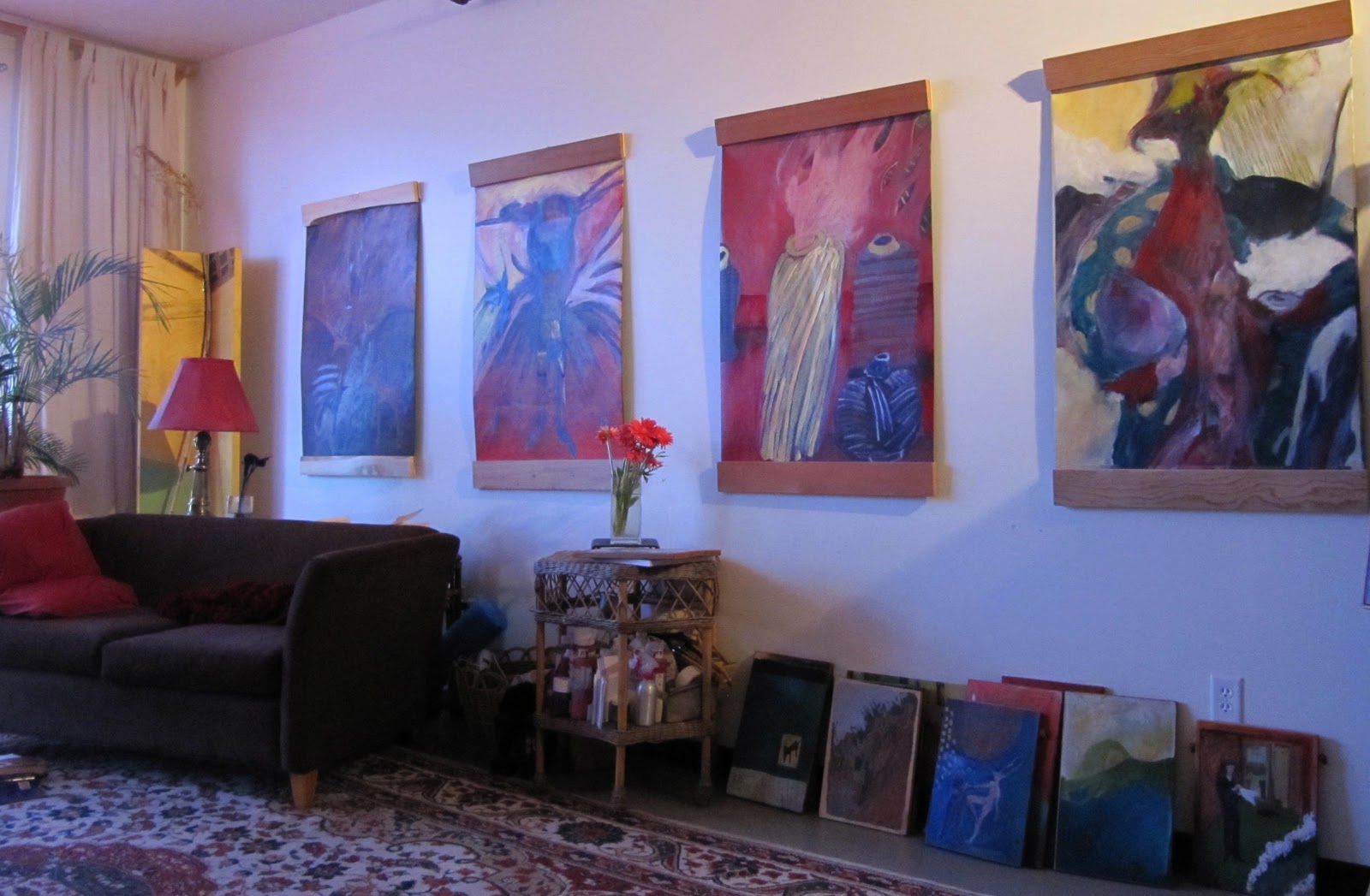
All these paintings  are on industrial or printing paper, mostly around 3' X 4'. Some are in an ingenious frame at the top and bottom for hanging without glass. The frame is extra. These are some of the images, make an offer and get this wild princess free from court life and back into printing.

Tryst
Raining Face
Bear
Hierophant Scale
Shadowing an Angel
Three Sale Paintings on Paper with Frames

Making Sacred
Hopscotch Deva


Wednesday, September 29, 2010

Skeleton Woman Part 4 & 5 UNDEFENDED LOVE & EMOTIONAL PRESENCE

Skeleton Woman Story
as Metaphor for Creative Process:

In the Inuit story the fisherman has snagged Skeleton Woman from the depths and inadvertently brought her back home with him. He has untangled and ordered her bones, wrapped her in furs and fallen asleep. She creeps closely and drinks from the single tear forming in his eyes as he sleeps.

  Part 4 UNDEFENDED LOVE, Surrender

In this stage in creative process we must surrender our innocence to be renewed. Sleep in fairy tales represents trusting in the deeper meaning. Things change in sleep. We can rest assured that things take care of themselves; we do not have to track and translate anything. Sleep is a practice for death, the place of no time, dreamtime. It is a return to innocence or to the deepest level of being. In the process it is a turning off of the conscious mind to be present in another way. Sleep is rebirth. You can not fall into sleep on demand but must release unto it. This stage of the story calls for letting go to what may be. Slumber, bound up with innocence, requires trust to sleep in someone's presence. It is the same in love, without surrender there is holding back and being held back. This is an important aspect of the creative process. In our invocation and meditation in painting circles we call forth this sacred place of resource.

The Latin word, intimus, means about one's nature. True essence of who you are is what is required for Transformational Painting to be transformational. Undefended is vulnerable and intimate. We can only remain there with an open heart. We are asked to let go of mental ideas of what we want to create and draw from our a deeper experience. Only then will the painting paint itself, not in a trite or secondhand way but with personal power. As the fisherman begins to trust in who he is and who she may be, he invites a genuine exchange.

This part is essential for the engagement in the story and also in painting. It is not so much a labor, but surrender, letting go. It is the opening to release the traditional control of painting or poetry, believing in the birth/death/birth cycle. It is a learning to trust our imagination, our hands and our heart. Trust is the muscle that develops as you continue to return again and again to call forth images of the psyche and then surrender to whatever shows up.

 
Surrender is necessary for emotional presence. When our commitment to knowing and revealing ourselves is greater than the call to hide or defend, then what keeps us isolated and disconnected falls away. Surrendering the attitudes of self-defense is making space for creative encounters. Authentic emotional freedom is to no longer need validation and agreement from another to be who we are. We have such profound yearnings for closeness and yet hesitate to be closer to ourselves. Painting is a way to open to that love of self that is the deepest core of who we are. How we love our self is how we love others. Painting is a way of loving self.


Part 5 EMOTIONAL PRESENCE, Realizing wounds to call forth New Vision 

  
Wearing our personalities lightly, we experience everything more directly, more profoundly, and more intensely.                                                                              
Jett Psaris and Marlena Lyons


In myth and fairytale, the tear holds creative power. Tears heal, reunite, bring nurturance and call in spirit. It is the tear that begins skeleton woman's transformation. So in our painting it is not enough to engage with full presence, riding out the cycles of disgust and delight, something deeper is called for here. The act of external creating is not enough, for the wounded cannot be bandaged from the outside. We are required to put our true longing on the table, naked and raw. It is being vulnerable, not only in the creative process but also with the lens of the group. There is a safety net in that we can decide how far to go, but unless we are willing to not defend our self in the face of Skeleton Woman and shed the tear, the transformation will wait until another time.

The Quest for Vision is a way to practice emotional presence; to develop as Psaris and Lyons say in their book Undefended Love, "the capacity to be non judgmental and motiveless..."Most of us did not have this modeled by our parents. We may have tried as parents with our children to just be there for them without making things all better or judging them, but most of us have not experienced it our selves. 

Painting in a safe environment to feel what is going on inside and yet still stay in relationship to the process is a challenging practice that is supported by the group. So often participants that have been traumatized around art find total release and confidence with others who are in the same process. The buoyancy of the painting circle brings delight and confidence initially, which is sometimes followed by judgment of self, others and facilitator. The empowering experience can quickly become a disaster. Good! We are moving into the real work. We are beginning to develop the muscles that we came here to use, that of emotional presence.

It is the willingness to stay with what is going on, that is, not dramatize it or amplify it, but witness it against the backdrop of being. When the mood of the class is successful there is an over all texture of being in a greater framework that allows the small self to feel what comes up and let it flow through.

When we can release to the thirst of our own pain and passion in our creative process something ALCHEMIC TAKES PLACE. Tears are magical in myths and fairytales. In Skeleton Woman the fisherman is feeling his loneliness, his acute sickness for that psychic place, for that wild knowing. Our healing tears come natural when we step into the creative process we have felt bared from.