Tuesday, October 26, 2010

Post Open Studio Tour Notes


Post OPEN STUDIO Notes

Thank you to all of you who had the opportunity to come by the Tannery for the Open Studio Tours. There was an abundant turnout through the first weekend of sunshine and the second one of rain. I had some fascinating conversations which strengthens my view that the arts like every other institution in our country and eventually the world are on the brink of some radical shifts. And as you know if our conversation drifted in that direction, I believe, people want the art process back in their personal lives. Those of you that read this newsletter or blog and/or came through on the studio tours are already in the choir.

Often, however, we do not realize the stimulus that is needed until after it happens, like the incredible creative growth that was stimulated by the Beatles' burst into the music scene. This time it may not be the content delivered by superstars, but a grassroots movement that is budding. We are going to experience some extraordinary changes in the art world in the next few years. They are already afoot so look at your own life and dreams to see how important the mythopoeia process is in relation to who you are becoming.
I want to thank all of you who made a point of responding to me personally about my painting images. It was hugely important to me, as I tend keep my work in my own little world. Thank you to those of you that bought sale paintings! With that specially earmarked money I have a good beginning to again explore the world of monoprinting and will keep you informed about that journey.

Monday, October 25, 2010

CULTIVATING AWARENESS of WHOLENESS through PAINTING New Mexico July 13-15 2010

The assumptions at the core of all mystical traditions, is that we are already whole and complete. We have all experienced the paradox of absolute wholeness in spite of fact that everything in our incarnation and culture reflects separation. This is the reason that those experiences of wholeness can slip by us or be forgotten so easily. Painting for me is an apt practice for re-membering wholeness. The essential key to this process is imagination. To cultivate imagination from a place of whole being, rather than mental faculties means letting go of mental chatter. As the imagination grows and ripens we are able to engage reality in a fuller context. I am not speaking of fantasy but consciously inviting the soul energies to be expressed through the personality by allowing imagination to transcend the polarities that are known.


The imagination is a means to tap into the not-yet-recognized dimensions of our being as we cultivate awareness of unity which includes diversity. It takes practice to bypass the rational mind, materialistic orientation and fear-based defenses. Imagination as a practice in Transformational Painting brings awareness to the blueprint of Oneness even as we experience the illusion of duality.

There are many ways to develop the imagination and tend to the deeper relationship of our wholeness: storytelling, dream work, soul-orientated poetry, shadow work, trance dancing, drumming, ritual, nature, active imagination, symbolic artwork and many others. In this workshop through TRANSFORMATIONAL PAINTING we focused on those below.


• Our dream life is one of the most intelligent dimensions of our lives. To become more conscious of our dreams is to integrate, heal and engage in a dialogue with the soul through metaphor. This kind of painting in its purity is ‘awake dreaming.’ We use dream techniques to go deeper into our imagery; not in an analytical way but to stimulate our process, making new connections and revelations.
• We cannot help but paint our personal mythology. Our journals with reflections and digital images of the paintings stages track the limiting story as well as the evolving story that wants to break through our illusions.
• The many voices within our selves seem real, as they sometimes take over our feelings, thinking and expression. It is important to establish a baseline. The practice of clearing and opening to the not-yet-known material through active imagination is a major component in this painting.

PLACE plays a powerful role in inner development, calling forth collective archetypal energies from the land to meet the individual with new perspectives and visions. In this New Mexico workshop, near Abiquiu on the Chama River we painted for three days in a private adobe studio where creative practice emerged with the mystery and enchantment of the Southwest. Many of the painters claimed breakthroughs and new insights in their works and personal life. In time the muscles of a soul-personality dialogue develop as we meet the tremendous challenge of discerning between personality and our greater self.

Monday, October 4, 2010

OPEN STUDIO TOURS October 2010

OPEN STUDIO TOURS 2010
October 9,10 & 16,17


HUGE SALE! 40 Large PAINTINGS ON PAPER must go to Finance the Dream of a large bed press (44" X 30") for Monoprinting, starting at $100. 

Meeting
Making a Red Ladder
Fairy Tales and myth are the language of the soul. Knowing the tales you are living shines the light of consciousness on the beliefs that sponsor our daily stories.  Sometimes sadly we are the last one to get the drama that is so obvious to others. Speaking of...........

I have a huge stack of large paintings on paper that need to be stored flat.  They take up a lot of room and have found there way under my bed which is now four feet high. I have a high ceiling,  but it is ludicrous to need a step ladder to get into bed. So this is how I found myself  in the tale of the Princess and the Pea wanting to change my bed of paintings  for a  press bed.

Princess Bed #1
Princess Bed #2
In the story, the Princess comes to the castle in a storm, wet and bedraggles. Her true value is not recognizable so she must be tested. She sleeps high  atop dozens of mattresses but notices that something is wrong, she is not comfortable.

I too have not been sleeping well, dreaming about making images in a new way, monorprints. Monoprints in them self is a  kind of Fairy Tale contradiction in that prints are usually multiples and mono is one of a kind.  I long for the immediacy that opens up space for spirit to intervene in the monoprint process which is so different from direct painting. The Universe as magical element is involved as I have  received a stack of large sheets of printing paper, perfect for this process.

The high bed in the Fairy Tale is connected to an impossible task, of sensing something out of order. For me the task is to convert the product of creativity to the means of creating something else.
Warrior

It is time to make room for new work. 

Different images emerge from different formats and materials. Painting is my passion and I will continue to paint even with the press. I am also still excited about the format of the tall two panel screens, which seem to be multiplying when I turn my back. I love the double sides and edges that invite embellishment of objects and silk ties. 

The paintings that I have been sleeping on are up for sale, very very reasonable, to facilitate the purchase of a press, inks, rollers, etc.

I will be moving my teaching studio from Live Oak to the West Side in November which is another reason to grant these images permission to find their new life. It does seem true that pieces of artwork have their own destiny like characters in a book that begin to dictate the plot. These paintings on paper have been murmuring to me at night like teenagers sneaking out the window at night. They want to go and are ready to set off in tothe world. So I must loosen my apron strings and see them off even if it means selling them for what you can pay. I need your help in this adventure otherwise I may turn to that Gorilla Artist tactic of leaving art around town as a random act of...
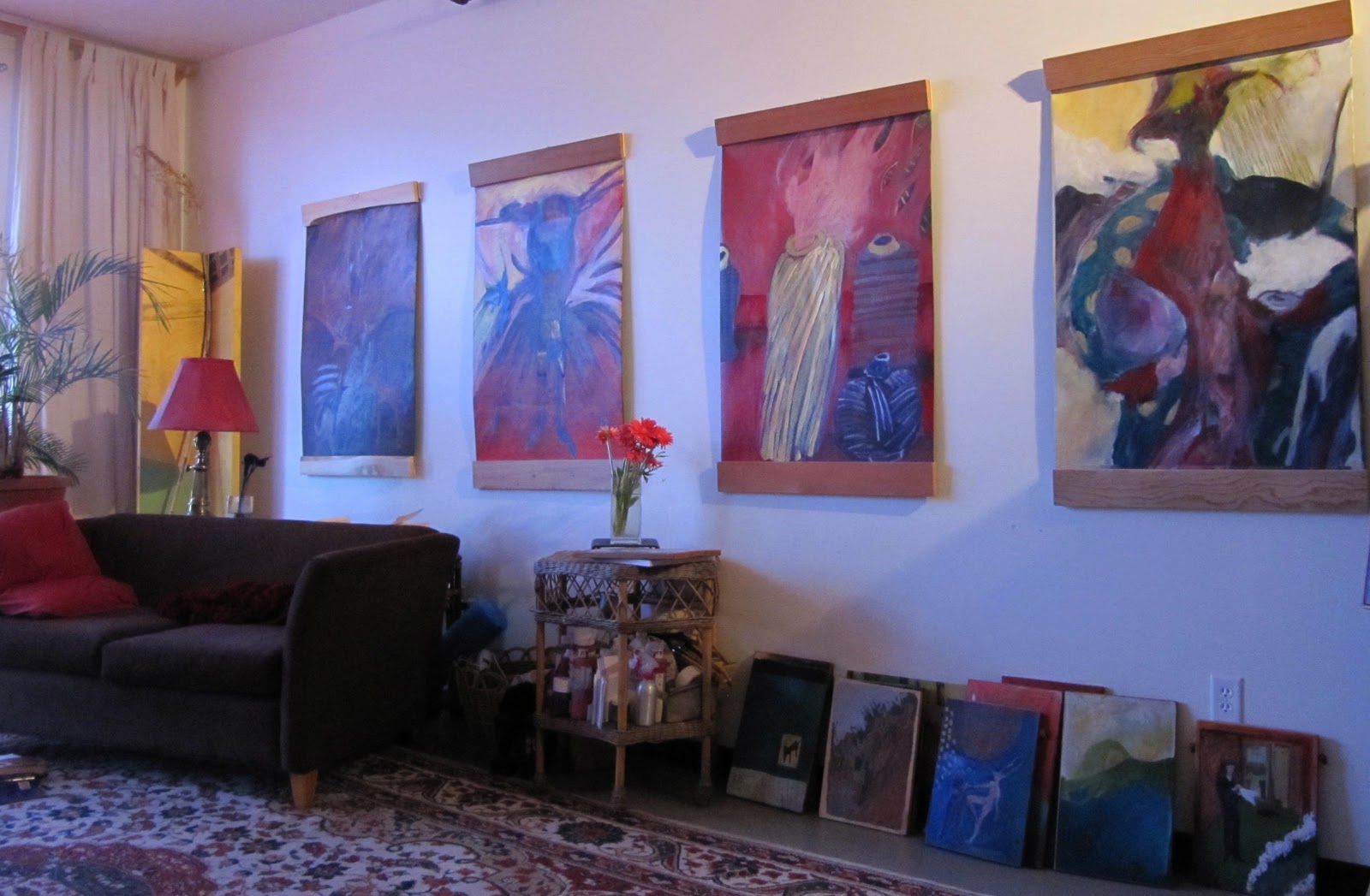
All these paintings  are on industrial or printing paper, mostly around 3' X 4'. Some are in an ingenious frame at the top and bottom for hanging without glass. The frame is extra. These are some of the images, make an offer and get this wild princess free from court life and back into printing.

Tryst
Raining Face
Bear
Hierophant Scale
Shadowing an Angel
Three Sale Paintings on Paper with Frames

Making Sacred
Hopscotch Deva


Wednesday, September 29, 2010

Skeleton Woman Part 4 & 5 UNDEFENDED LOVE & EMOTIONAL PRESENCE

Skeleton Woman Story
as Metaphor for Creative Process:

In the Inuit story the fisherman has snagged Skeleton Woman from the depths and inadvertently brought her back home with him. He has untangled and ordered her bones, wrapped her in furs and fallen asleep. She creeps closely and drinks from the single tear forming in his eyes as he sleeps.

  Part 4 UNDEFENDED LOVE, Surrender

In this stage in creative process we must surrender our innocence to be renewed. Sleep in fairy tales represents trusting in the deeper meaning. Things change in sleep. We can rest assured that things take care of themselves; we do not have to track and translate anything. Sleep is a practice for death, the place of no time, dreamtime. It is a return to innocence or to the deepest level of being. In the process it is a turning off of the conscious mind to be present in another way. Sleep is rebirth. You can not fall into sleep on demand but must release unto it. This stage of the story calls for letting go to what may be. Slumber, bound up with innocence, requires trust to sleep in someone's presence. It is the same in love, without surrender there is holding back and being held back. This is an important aspect of the creative process. In our invocation and meditation in painting circles we call forth this sacred place of resource.

The Latin word, intimus, means about one's nature. True essence of who you are is what is required for Transformational Painting to be transformational. Undefended is vulnerable and intimate. We can only remain there with an open heart. We are asked to let go of mental ideas of what we want to create and draw from our a deeper experience. Only then will the painting paint itself, not in a trite or secondhand way but with personal power. As the fisherman begins to trust in who he is and who she may be, he invites a genuine exchange.

This part is essential for the engagement in the story and also in painting. It is not so much a labor, but surrender, letting go. It is the opening to release the traditional control of painting or poetry, believing in the birth/death/birth cycle. It is a learning to trust our imagination, our hands and our heart. Trust is the muscle that develops as you continue to return again and again to call forth images of the psyche and then surrender to whatever shows up.

 
Surrender is necessary for emotional presence. When our commitment to knowing and revealing ourselves is greater than the call to hide or defend, then what keeps us isolated and disconnected falls away. Surrendering the attitudes of self-defense is making space for creative encounters. Authentic emotional freedom is to no longer need validation and agreement from another to be who we are. We have such profound yearnings for closeness and yet hesitate to be closer to ourselves. Painting is a way to open to that love of self that is the deepest core of who we are. How we love our self is how we love others. Painting is a way of loving self.


Part 5 EMOTIONAL PRESENCE, Realizing wounds to call forth New Vision 

  
Wearing our personalities lightly, we experience everything more directly, more profoundly, and more intensely.                                                                              
Jett Psaris and Marlena Lyons


In myth and fairytale, the tear holds creative power. Tears heal, reunite, bring nurturance and call in spirit. It is the tear that begins skeleton woman's transformation. So in our painting it is not enough to engage with full presence, riding out the cycles of disgust and delight, something deeper is called for here. The act of external creating is not enough, for the wounded cannot be bandaged from the outside. We are required to put our true longing on the table, naked and raw. It is being vulnerable, not only in the creative process but also with the lens of the group. There is a safety net in that we can decide how far to go, but unless we are willing to not defend our self in the face of Skeleton Woman and shed the tear, the transformation will wait until another time.

The Quest for Vision is a way to practice emotional presence; to develop as Psaris and Lyons say in their book Undefended Love, "the capacity to be non judgmental and motiveless..."Most of us did not have this modeled by our parents. We may have tried as parents with our children to just be there for them without making things all better or judging them, but most of us have not experienced it our selves. 

Painting in a safe environment to feel what is going on inside and yet still stay in relationship to the process is a challenging practice that is supported by the group. So often participants that have been traumatized around art find total release and confidence with others who are in the same process. The buoyancy of the painting circle brings delight and confidence initially, which is sometimes followed by judgment of self, others and facilitator. The empowering experience can quickly become a disaster. Good! We are moving into the real work. We are beginning to develop the muscles that we came here to use, that of emotional presence.

It is the willingness to stay with what is going on, that is, not dramatize it or amplify it, but witness it against the backdrop of being. When the mood of the class is successful there is an over all texture of being in a greater framework that allows the small self to feel what comes up and let it flow through.

When we can release to the thirst of our own pain and passion in our creative process something ALCHEMIC TAKES PLACE. Tears are magical in myths and fairytales. In Skeleton Woman the fisherman is feeling his loneliness, his acute sickness for that psychic place, for that wild knowing. Our healing tears come natural when we step into the creative process we have felt bared from.
Monday, August 23, 2010

Skeleton Woman Story Part 3 Concentration

Part II Inuit Skeleton Woman Story as Metaphor for Creative Process:
Mindless or Mindful                                               

Website Gallery V: Da'at, Bridged

In the East, Mind is  a field of intelligence which includes the entire physical body. the word mind is used as distinct from brain. Mind, like nature is vessel of being.  Mindful is an engagement of  knowing, feeling and sensing beyond the five senses. It can also be an engagement of the unknown. Mindless is an automatic reaction rather than response, because the mind is not embodied.

To return to our story, of Skeleton Woman and how it relates to the creative process. The snagging the of treasure begins the roller-coaster chase of delight and terror, the classic theme and traditional myth of creativity. To stand in front of your painting or in front of a blank canvas with emotional presence is the opportunity to be transparent in this adventure. The ego will ask who is the most beautiful, the most grand, or even the worst, always making comparisons to others. The small self does not want to know about the full cycle of creation which includes destruction. No, the slightest whiff of Death sends even the bold of heart into panic. It is no accident that the Buddha, archetype of lucidity, was said to have been tested with images of terror. Often in painting circle, the shadow is the first edge to surface, dragging in tow frightening stories that  have been tucked out of circulation for years.

The part of us that we are least conscious of is the shadow. It is so fundamental that it is an aspect of every archetype. In painting circle I have seen how the shadow can shift an entire painting locked into conservative progression into the arms of the gambler who will throw it away in a moment bravado. Our most profound doubts of ourselves surfaces as we quickly project them elsewhere so that we can flee. Like the fisherman in the story who brings up the potential treasure, we don't recognize what we have snagged as we take off running.
 
A painter in one of my classes did very well in the engagement of the process, but then rejected the  final painting, and began taking techniques classes madly. She ran from the simple language that her soul offered because it was not what she expected. She returned eventually, however,  looking for the the lively images that she had discarded. Sooner or later, one must kiss the beast most feared. The fisherman is our model of entering into relation with Lady Death to find right order. To do this we must stop reacting in blind terror fueled by fears of the past and future.
 
To be present in the moment means to surrender: not  to abandon, give up or give away, but to trust deeply yourself, NOW. Eckhart Tolle says NOW is the only place  you can experience the flow of life, so to surrender is to accept the present moment unconditionally and without reservation. It is a place of acceptance, without judgment. Judgment strangles the creative process. You find quickly in process painting that when you are doing rather than being the life of  your painting slips through your fingers. In  the state of being you know immediately what needs attention. This painting process develops the 'muscle of being'.

Deena Metzger contrasts poem and story, describing poem as a penetration into the essence of something. A poem expresses the inexpressible. She says good poetry goes deeply. Jane Hirshfield says poetry's work is the clarification and magnification of being. This kind of intuitive painting, which embodies creative process is vertical in all its implications. Story and prose, Metzger says, spreads out, wanting to speak to the mind, to the intellect. The horizontal gathers information, technique, momentum, while the vertical is out side of time, it changes your life as participant. Poetry evokes, as does the process vertical creative process.

Skeleton Woman Story Part 2 Mindless or Mindful

Part II  Inuit Skeleton Woman Story as Metaphor for Creative Process:
Mindless or Mindful                                               

Website Gallery V: Da'at, Bridged

In the East, Mind is  a field of intelligence which includes the entire physical body. the word mind is used as distinct from brain. Mind, like nature is vessel of being.  Mindful is an engagement of  knowing, feeling and sensing beyond the five senses. It can also be an engagement of the unknown. Mindless is an automatic reaction rather than response, because the mind is not embodied.

To return to our story, of Skeleton Woman and how it relates to the creative process. The snagging the of treasure begins the roller-coaster chase of delight and terror, the classic theme and traditional myth of creativity. To stand in front of your painting or in front of a blank canvas with emotional presence is the opportunity to be transparent in this adventure. The ego will ask who is the most beautiful, the most grand, or even the worst, always making comparisons to others. The small self does not want to know about the full cycle of creation which includes destruction. No, the slightest whiff of Death sends even the bold of heart into panic. It is no accident that the Buddha, archetype of lucidity, was said to have been tested with images of terror. Often in painting circle, the shadow is the first edge to surface, dragging in tow frightening stories that  have been tucked out of circulation for years.

The part of us that we are least conscious of is the shadow. It is so fundamental that it is an aspect of every archetype. In painting circle I have seen how the shadow can shift an entire painting locked into conservative progression into the arms of the gambler who will throw it away in a moment bravado. Our most profound doubts of ourselves surfaces as we quickly project them elsewhere so that we can flee. Like the fisherman in the story who brings up the potential treasure, we don't recognize what we have snagged as we take off running.
 
A painter in one of my classes did very well in the engagement of the process, but then rejected the  final painting, and began taking techniques classes madly. She ran from the simple language that her soul offered because it was not what she expected. She returned eventually, however,  looking for the the lively images that she had discarded. Sooner or later, one must kiss the beast most feared. The fisherman is our model of entering into relation with Lady Death to find right order. To do this we must stop reacting in blind terror fueled by fears of the past and future.
 
To be present in the moment means to surrender: not  to abandon, give up or give away, but to trust deeply yourself, NOW. Eckhart Tolle says NOW is the only place  you can experience the flow of life, so to surrender is to accept the present moment unconditionally and without reservation. It is a place of acceptance, without judgment. Judgment strangles the creative process. You find quickly in process painting that when you are doing rather than being the life of  your painting slips through your fingers. In  the state of being you know immediately what needs attention. This painting process develops the 'muscle of being'.

Deena Metzger contrasts poem and story, describing poem as a penetration into the essence of something. A poem expresses the inexpressible. She says good poetry goes deeply. Jane Hirshfield says poetry's work is the clarification and magnification of being. This kind of intuitive painting, which embodies creative process is vertical in all its implications. Story and prose, Metzger says, spreads out, wanting to speak to the mind, to the intellect. The horizontal gathers information, technique, momentum, while the vertical is out side of time, it changes your life as participant. Poetry evokes, as does the process vertical creative process.

Skeleton Woman Story Part 1 Invitation


THE INVITATION, synchronicity, dreamtime & imagination

Part I: Inuit SKELETON WOMAN Story
                       as Metaphor of Creative Process
Website Gallery I:


An ancient Sufi adage says, Trinkets can be easily bought in the market place, but for treasures you must dive into the depths.

The treasure you receive from creative process is equal to your willingness to enter into the depths of the psyche. The portal into our essence demands the discipline of curiosity and wonderment of the unfolding images of our deep being. Like the fisherman in the story, (see Introduction to Story of Skeleton Woman) we are unaware that we do not know. Also like him, we are hungry for relationship to our creative self but may not recognize it as we search for a way to coast for a while. We think that we can play around, unaware of the profound journey that awaits us. There may be a ticket in our fist at this very moment, that must be paid for even though we have no idea of what or how or when we signed up for the ride.

Clarissa Pinkola Estes talks about three different attitudes in fairy tales of the one who happens on to treasure. The first is the seeker, who does not believe in the nurturing of the soul because of other priorities. Like the guest who politely indulged the celebrant by joining the painting group and dropped into an exquisite soul process and then wanted to continue painting instead of going to dinner.

The second attitude, like the fisherman, is that of the bumbler; the one who comes across treasure while hoping for something else. We have all been blindsided when our deepest desire sneaks upon us. We are just going to take one class. We have no intention of turning the hallway into an on-going mural, or the bathroom in to a darkroom. This was how I traveled to Japan seemingly by default. A journey that ended up being a turning point in my life.

The third is the sacred approach of the one who is looking for a path beyond the borders of what is known. Those that are looking for divine connection,  but not sensing perhaps the new demands that come along with it.  Luckily enough, however, whatever your attitude, the path of adventure is open to you. When you come upon accidental treasure it will propose choices that you could not have envisioned. Often synchronicities are the clues in the treasure map.


SYNCHRONICITY

The difference between coincidence and synchronicity is that the latter is related to our soul path.                                                                  David Richo


Happening on to a treasure is not an accident, but an act of destiny. And as with dreams, if it is not acknowledged, it can stick fast or return again and again, until you pay attention to it. If it is still ignored, calamity will be arranged. Carl Jung coined the word synchronicity, which brought articulation to a variety of experiences that are well integrated into Eastern philosophy, whereas in the West the same experiences have jockeyed between superstition and divine intervention. Most of the population of the world is aware of signs that speak guidance, warning, or send information for the soul. Synchronicity can be used as a powerful tool through journey of the physical world. The more conscious we are of synchronicity the more is appears and the more useful it is
       
DREAMTIME
 
Out beyond ideas of wrong doing and right doing
                        There is a field    
                         I'll meet you there  
                                                                                                Rumi

Dreamtime is outside of psychological time.  Waking dreams, nighttime dreams, myths, the arts, or being present in the now are portals that offer access to the greater realm of existence. If existence means to stand out, then Dreamtime is what stands behind that. It is the background which becomes another kind of vessel. This other vessel, Dreamtime, is traditionally anchored in our cultures stories, traditions and mythological origins. It is the rich body of experience passed on through generations which gives value and understanding of relationship to each other, nature, and place. When a culture is lacking that resource they will borrow or create it through popular culture. For lack of this resource there is a current movement to work the edge of the much needed evolution of our civilization by creating a feminine power model. Others, like Andrew Cohen, are extending the traditional model of spiritual enlightenment to include social evolutionary edge. What Dreamtime do you function from?

IMAGINATION

The soul journey requires the constant use of imagination...
for without imagination, there are no relationships, no
creativity and no soul.
                                                                  Andrew Scheider

Imagination is an essential aspect of knowing the world, inner as much as outer. Of the four aspects of learning, our culture tends to value thinking above imagination, sensing and feeling. All four are critical to a balanced function for learning about our place in the world. Imagination is necessary to access and retrieve images. Our ego function is confused by imagination, especially when it is not honored in the culture.

Images from Dreamtime are the language of the soul. If you have spent time with your nighttime dreams, events in life that feel like waking dreams, synchronicities or images that spontaneous emerge from writing or visual arts activities, you know that what seems bizarre and ridiculous at first, always has some kind of pertinent guidance. I don't mean wrenching out some far fetched message, but an actual body 'aha' will arise that makes a difference in daily perceptions. The Universe is constantly in dialogue with us. One way of understanding metaphoric language is to imagine that all parts of the dream, poem, Skeleton Woman story are aspects of ones self. Often the role of the soul is personified helping us to experience our innate wholeness.